AI by Hand ✍️

AI by Hand ✍️

Graph Convolutional Network (GCN) by Hand ✍️

Calculating AI by Hand: 20 of 28

Prof. Tom Yeh's avatar
Prof. Tom Yeh
Feb 17, 2024
∙ Paid

Library › Calculating AI by Hand ✍️

  1. Matrix Multiplication by Hand ✍️

  2. Multi Layer Perceptron (MLP) by Hand ✍️

  3. Backpropagation by Hand ✍️

  4. SVM by Hand ✍️

  5. Batch Normalization by Hand ✍️

  6. Dropout by Hand ✍️

  7. Recurrent Neural Network (RNN) by Hand ✍️

  8. LSTM by Hand ✍️

  9. Deep RNN by Hand ✍️

  10. Self Attention by Hand ✍️

  11. Transformer by Hand ✍️

  12. Autoencoder by Hand ✍️

  13. Variational Auto Encoder (VAE) by Hand ✍️

  14. Sparse Auto Encoder (SAE) by Hand ✍️

  15. Generative Adversarial Network (GAN) by Hand ✍️

  16. Sampling a Sentence by Hand ✍️

  17. Residual Network by Hand ✍️

  18. U-Net by Hand ✍️

  19. Discrete Fourier Transform by Hand ✍️

  20. Graph Convolutional Network (GCN) by Hand ✍️

  21. CLIP by Hand ✍️

  22. Vector Database by Hand ✍️

  23. Mixture of Experts (MoE) by Hand ✍️

  24. Switch Transformer by Hand ✍️

  25. Mamba's S6 by Hand ✍️

  26. Sora's Diffusion Transformer (DiT) by Hand ✍️

  27. BitNet by Hand ✍️

  28. Reinforcement Learning with Human Feedback (RLHF) by Hand ✍️

Graph Convolutional Networks (GCNs), introduced by Thomas Kipf and Max Welling in 2017, have emerged as a powerful tool in the analysis and interpretation of data structured as graphs.
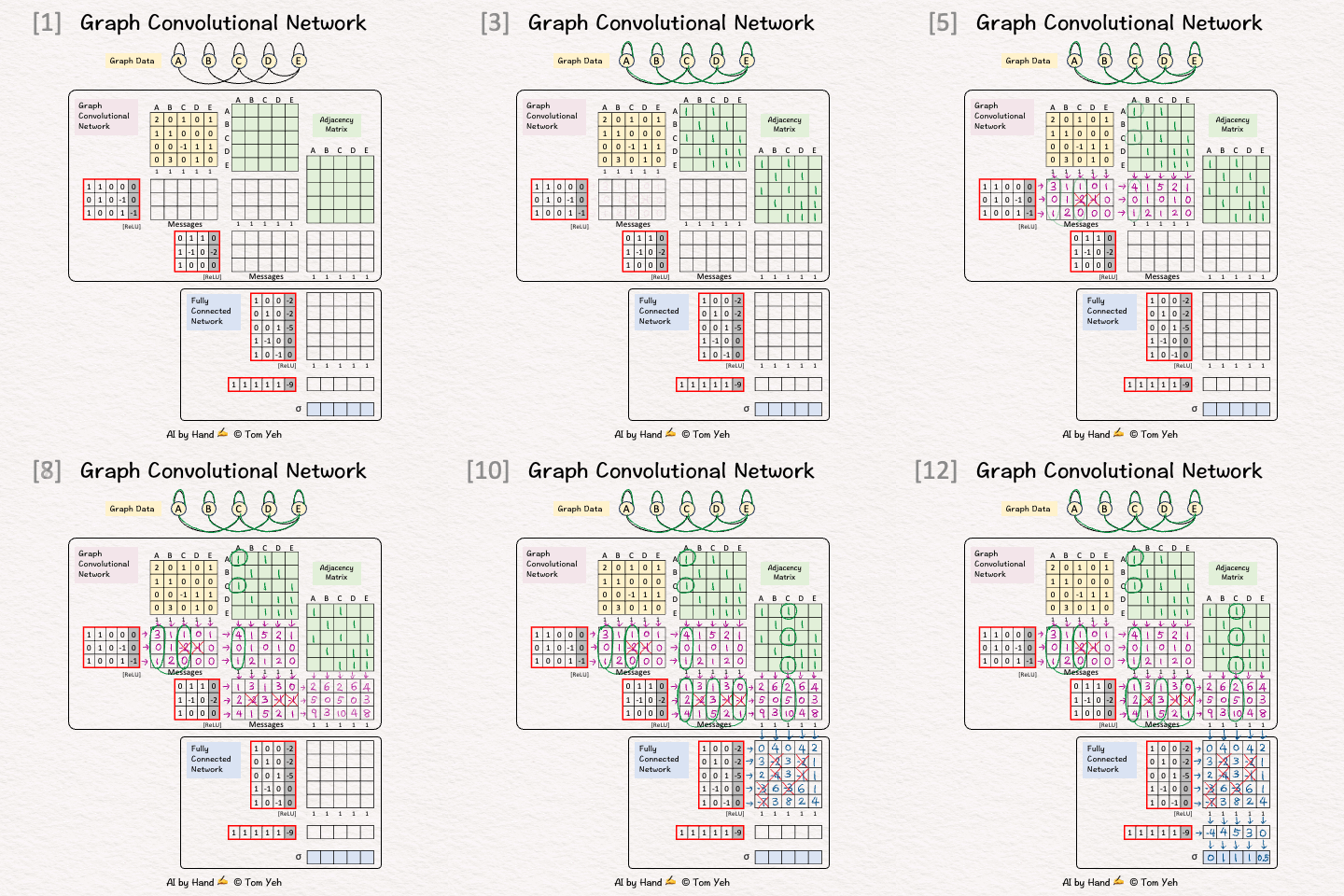
GCNs have found many successful applications:

  • Social network analysis

  • Recommendation systems

  • Biological network interpretation

  • Drug discovery

  • Molecular chemistry

This exercise demonstrates how GCN works in a simple application: binary classification.

Goal

Predict if a node in a graph is X.

Architecture

🟪 Graph Convolutional Network (GCN)

  1. GCN1(4,3)

  2. GCN2(3,3)

🟦 Fully Connected Network (FCN)

  1. Linear1(3,5)

  2. ReLU

  3. Linear2(5,1)

  4. Sigmoid

Simplications:

  • Adjacent matrices are not normalized.

  • ReLU is applied to messages directly.

Setup

Step 1 of 12: Given
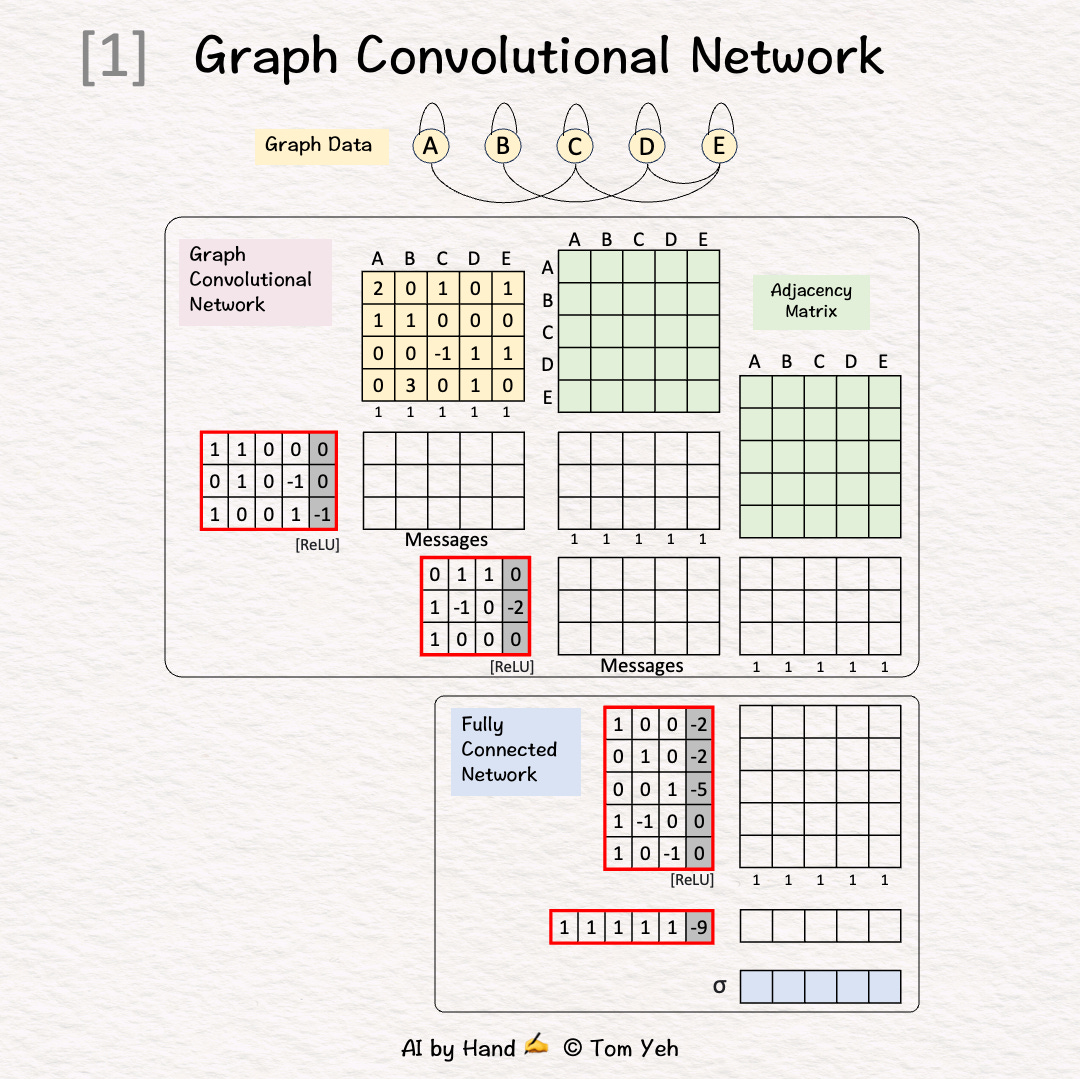
  • A graph with five nodes A, B, C, D, E


Step 2 of 12: Adjacency Matrix (Neighbors)
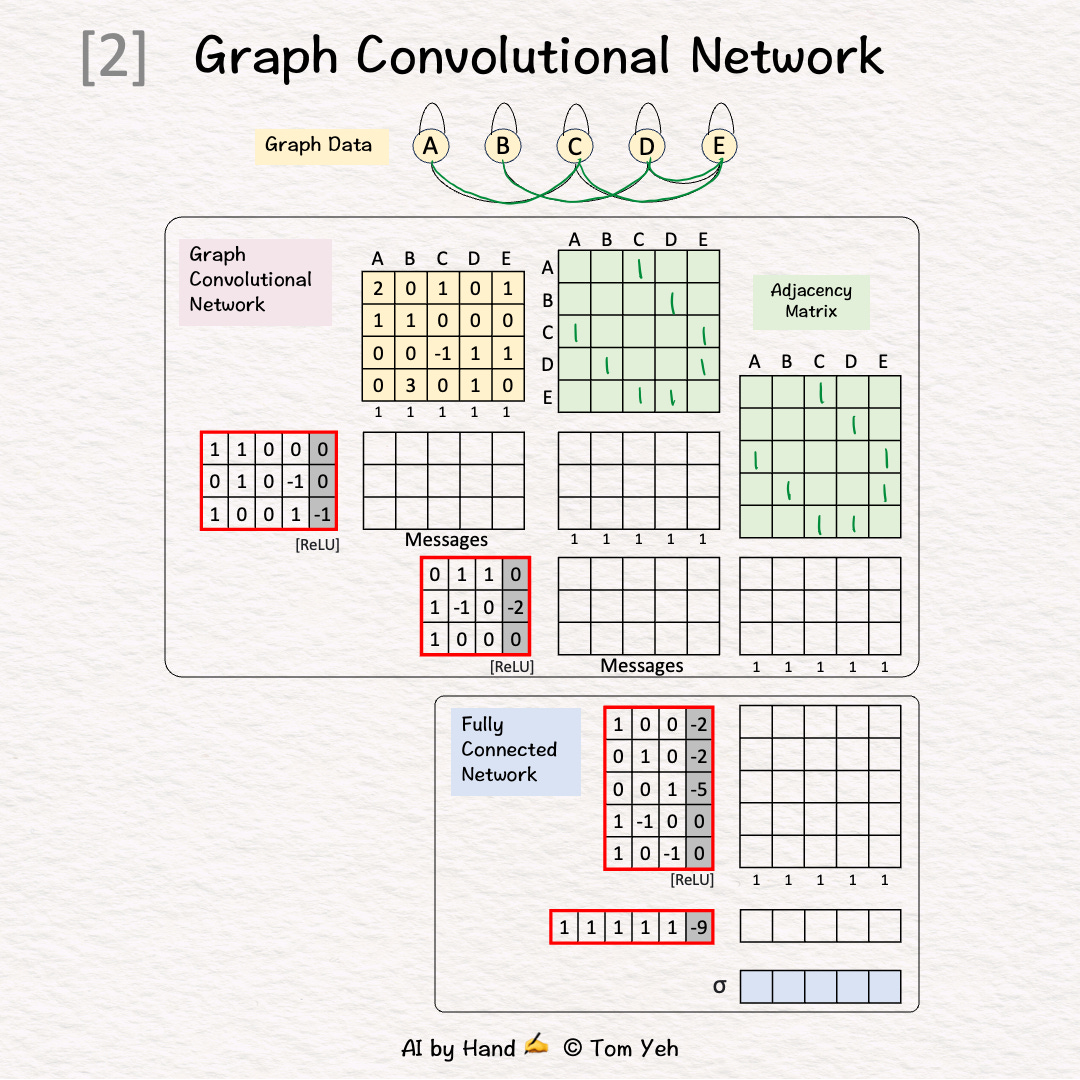
  • Add 1 for each edge to neighbors

  • Repeat in both directions (e.g., A->C, C->A)

  • Repeat for both GCN layers


Step 3 of 12: Adjacency Matrix (Self)
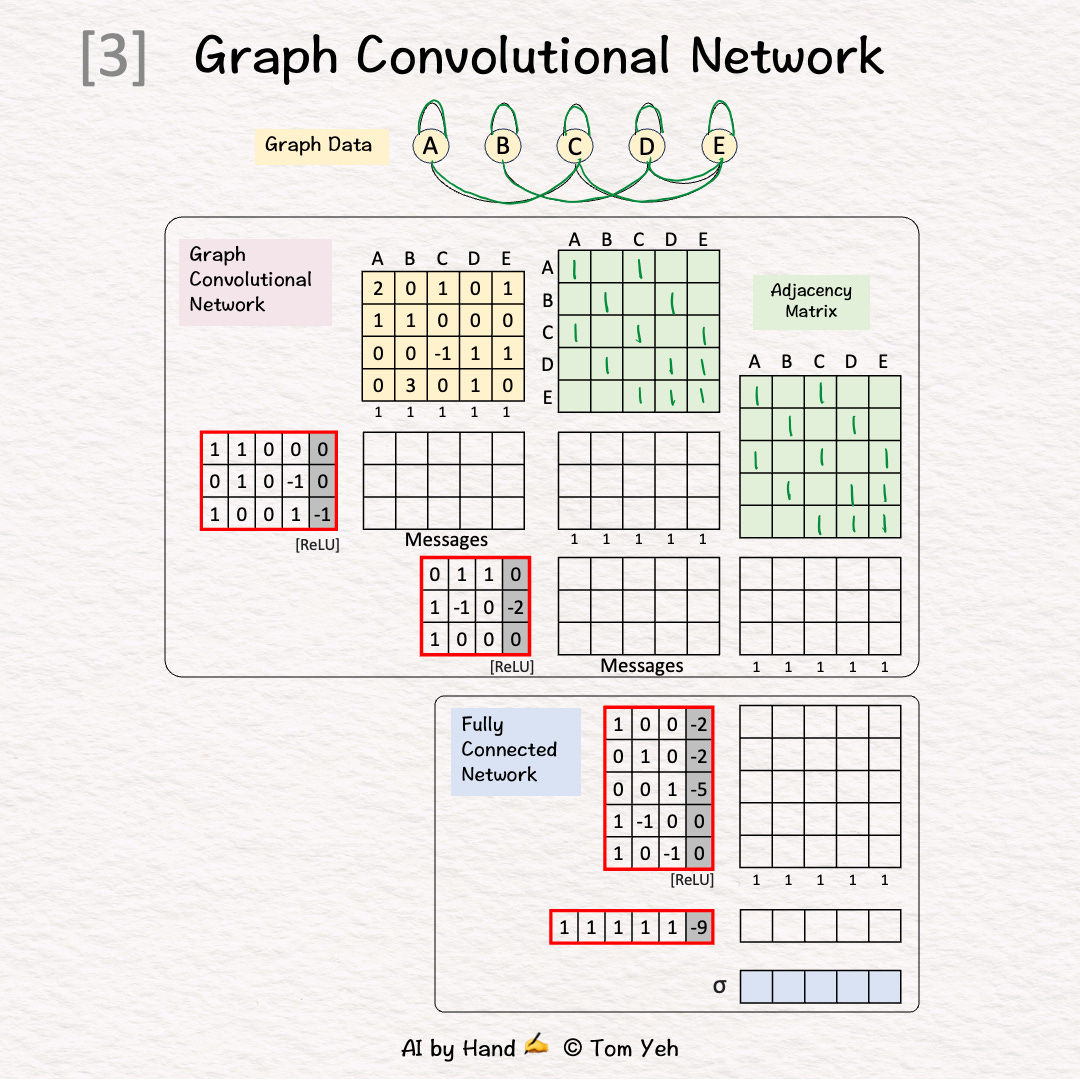
  • Add 1's for each self loop

  • Equivalent to adding the identity matrix

  • Repeat for both GCN layers

This post is for paid subscribers

Already a paid subscriber? Sign in
© 2026 Tom Yeh · Privacy ∙ Terms ∙ Collection notice
Start your SubstackGet the app
Substack is the home for great culture