AI by Hand ✍️

AI by Hand ✍️

Deep RNN by Hand ✍️

Calculating AI by Hand: 9 of 28

Prof. Tom Yeh's avatar
Prof. Tom Yeh
Mar 23, 2024
∙ Paid

Library › Calculating AI by Hand ✍️

  1. Matrix Multiplication by Hand ✍️

  2. Multi Layer Perceptron (MLP) by Hand ✍️

  3. Backpropagation by Hand ✍️

  4. SVM by Hand ✍️

  5. Batch Normalization by Hand ✍️

  6. Dropout by Hand ✍️

  7. Recurrent Neural Network (RNN) by Hand ✍️

  8. LSTM by Hand ✍️

  9. Deep RNN by Hand ✍️

  10. Self Attention by Hand ✍️

  11. Transformer by Hand ✍️

  12. Autoencoder by Hand ✍️

  13. Variational Auto Encoder (VAE) by Hand ✍️

  14. Sparse Auto Encoder (SAE) by Hand ✍️

  15. Generative Adversarial Network (GAN) by Hand ✍️

  16. Sampling a Sentence by Hand ✍️

  17. Residual Network by Hand ✍️

  18. U-Net by Hand ✍️

  19. Discrete Fourier Transform by Hand ✍️

  20. Graph Convolutional Network (GCN) by Hand ✍️

  21. CLIP by Hand ✍️

  22. Vector Database by Hand ✍️

  23. Mixture of Experts (MoE) by Hand ✍️

  24. Switch Transformer by Hand ✍️

  25. Mamba's S6 by Hand ✍️

  26. Sora's Diffusion Transformer (DiT) by Hand ✍️

  27. BitNet by Hand ✍️

  28. Reinforcement Learning with Human Feedback (RLHF) by Hand ✍️

A Deep Recurrent Neural Network (RNN) extends a basic single-layer RNN into multiple layers of hidden states, effectively incorporating deep learning into the RNN architecture.

How does a Deep RNN work?

Setup

Step 1 of 12: Given
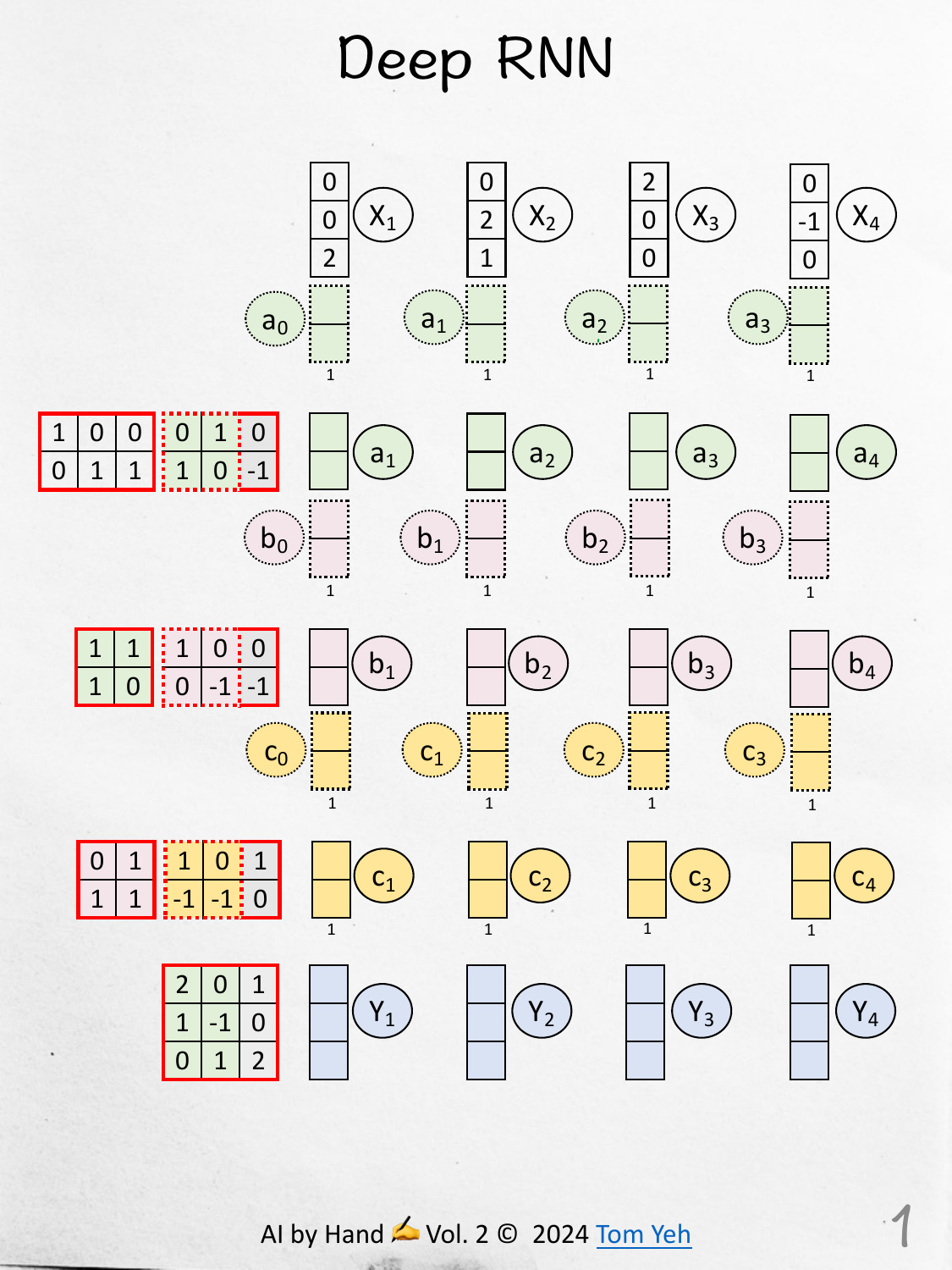
  • A sequence of four inputs X1, X2, X3, X4 ⬛️

  • Recurrent weights and biases for hidden layers a 🟩, b 🟧, c 🟪, and the output layer y 🟦.


Step 2 of 12: Initialize Hidden States
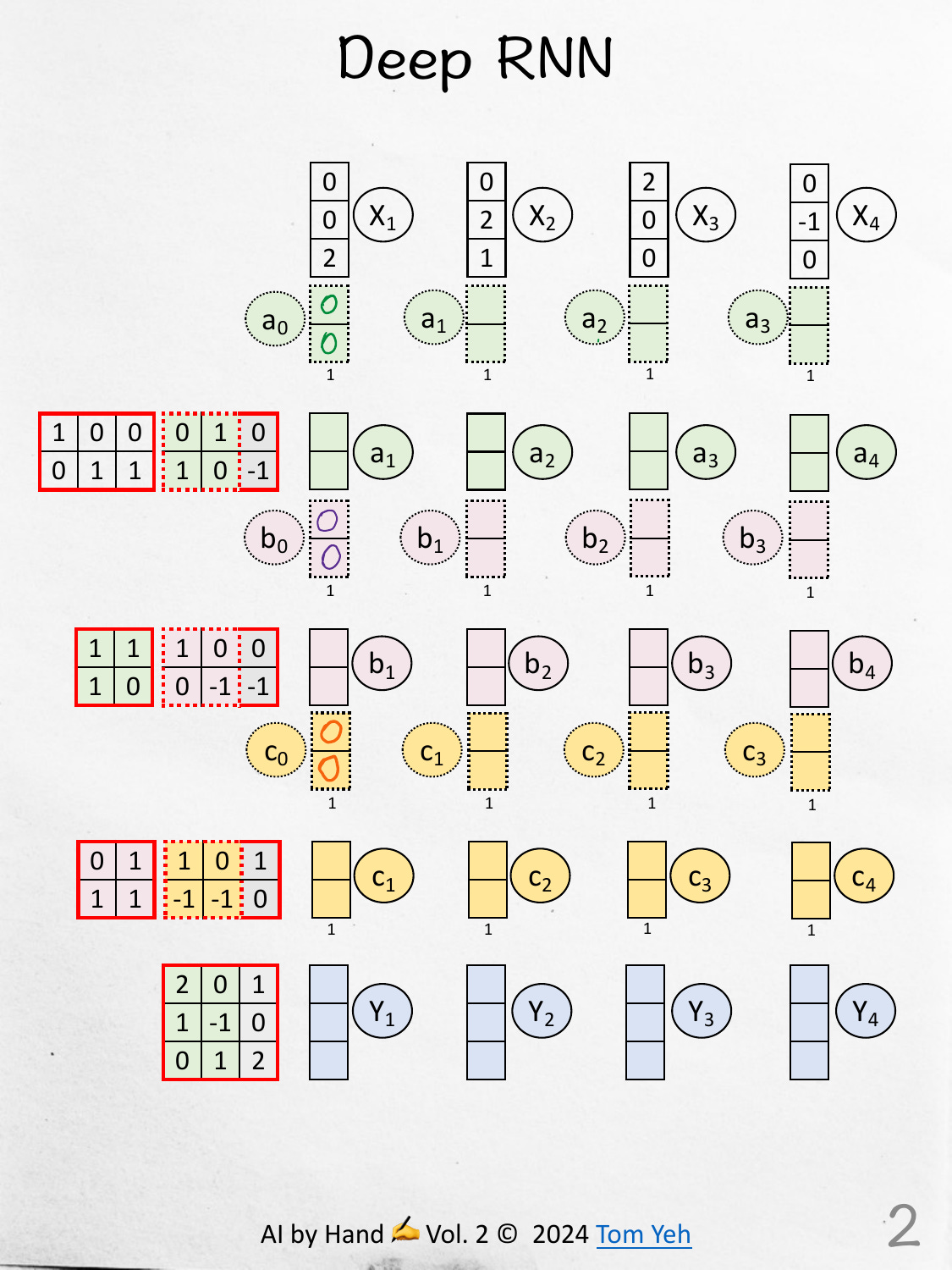
  • Set a0, b0, c0 to zeros

Process X1 (t = 1)

Step 3 of 12: First Hidden Layer (a)
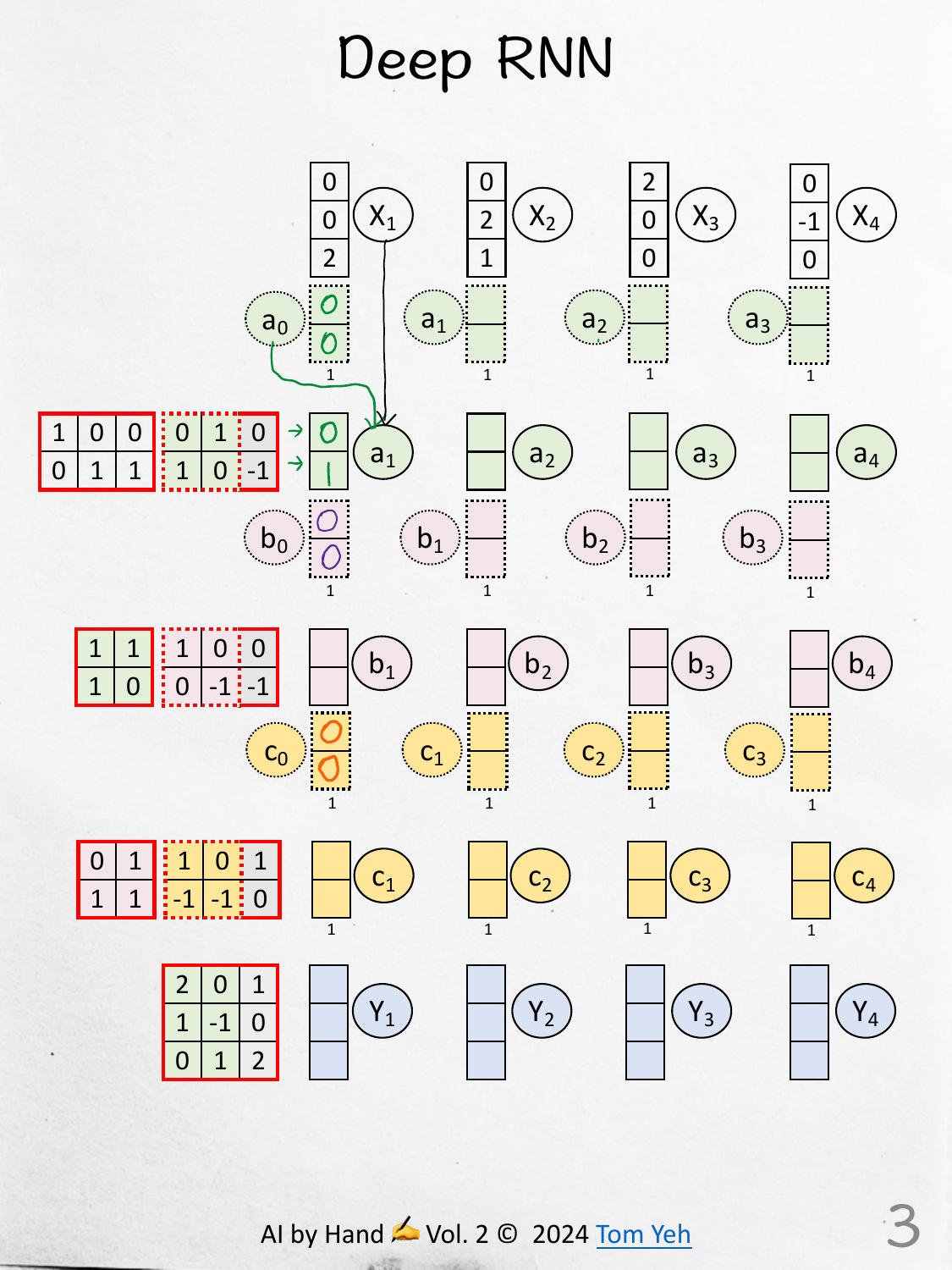
  • The transformation matrix is horizontal concatenation of input weights, hidden state weights and biases, visualized as [⬛️ | 🟩 | ⬜️] .

  • The state matrix is vertical concatenation of input X1, previous hidden state a0, and an extra 1, visualized as [⬛️ ; 🟩 ; 1].

  • Multiply the two matrices to obtain new hidden state a1 = [0 ; 1].

This post is for paid subscribers

Already a paid subscriber? Sign in
© 2026 Tom Yeh · Privacy ∙ Terms ∙ Collection notice
Start your SubstackGet the app
Substack is the home for great culture