

Library › Calculating AI by Hand ✍️
Batch Normalization by Hand ✍️
Reinforcement Learning with Human Feedback (RLHF) by Hand ✍️
Batch normalization is a common practice to improve training and achieve faster convergence. It sounds simple. But it is often misunderstood.
🤔 Does batch normalization involve trainable parameters? tunable hyper-parameters? or both?
🤔 Is batch normalization applied to inputs, features, weights, biases, or outputs?
🤔 How is batch normalization different from layer normalization?
This hands-on exercise can help shed some light on these questions.
Forward Pass
Step 1 of 7: Given
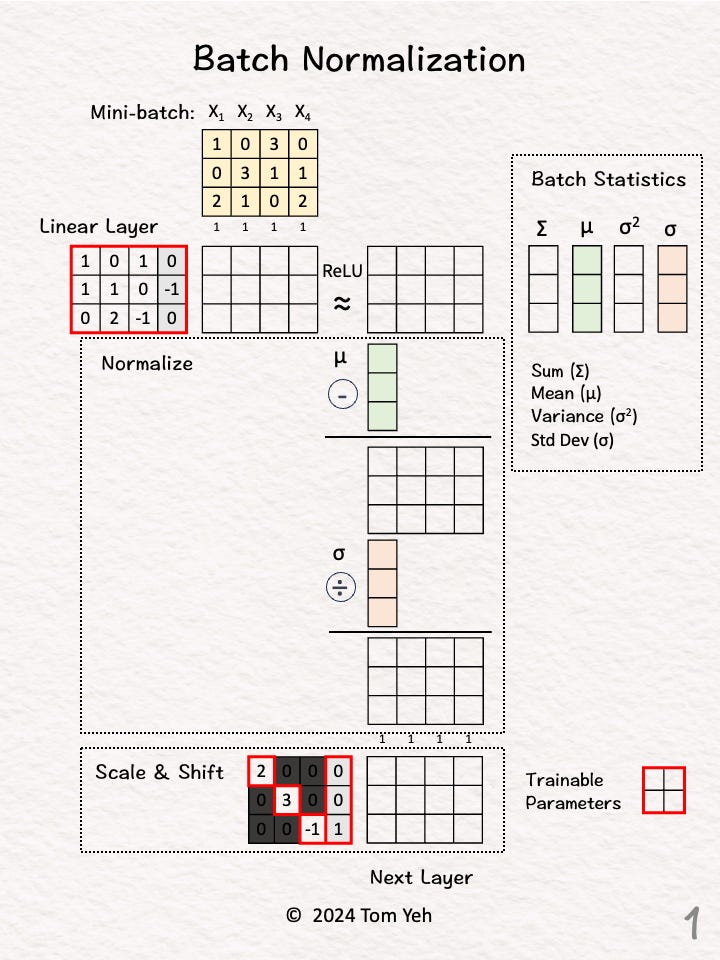
A mini-batch of 4 training examples, each has 3 features.
Step 2 of 7: Linear Layer
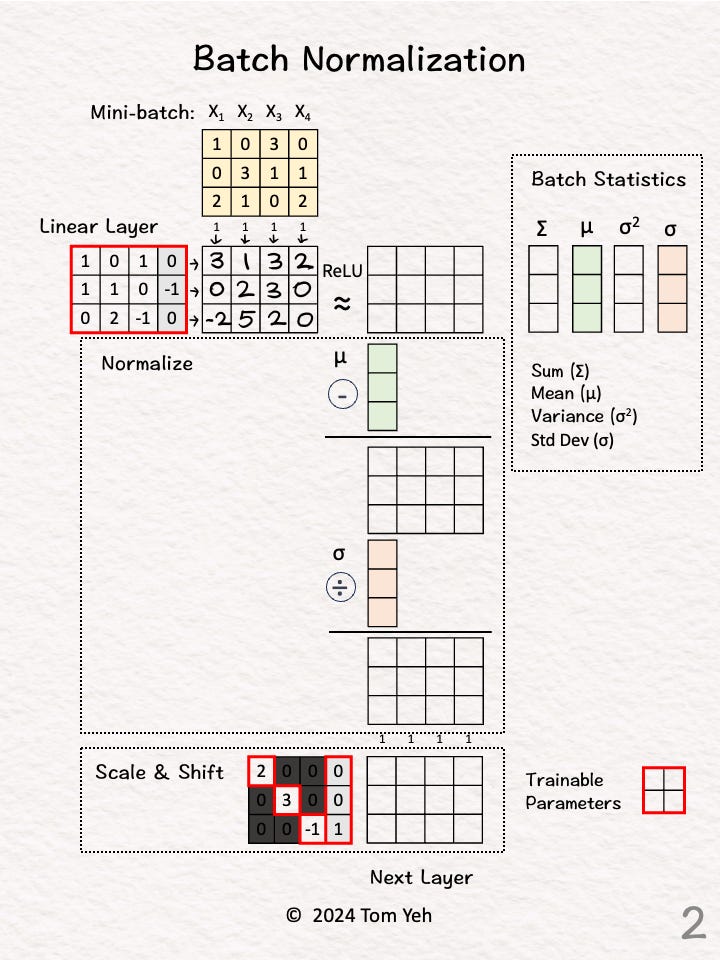
Multiply with the weights and biases to obtain new features
Step 3 of 7: ReLU
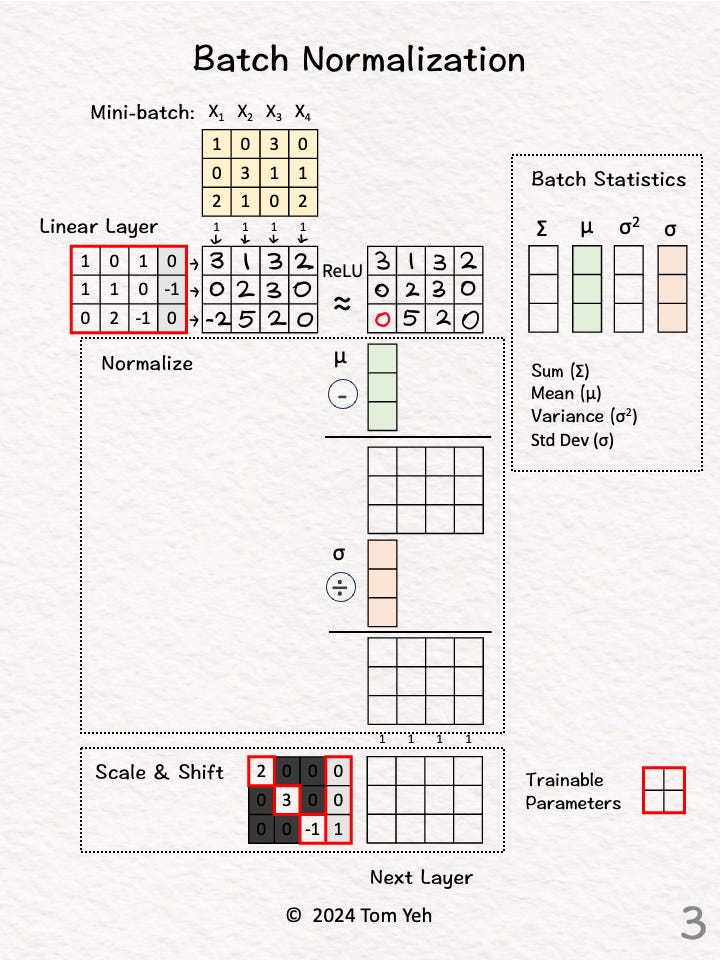
Apply the ReLU activation function, which has the effect of suppressing negative values. In this exercise, -2 is set to 0.
Batch Normalization
Step 4 of 7: Batch Statistics
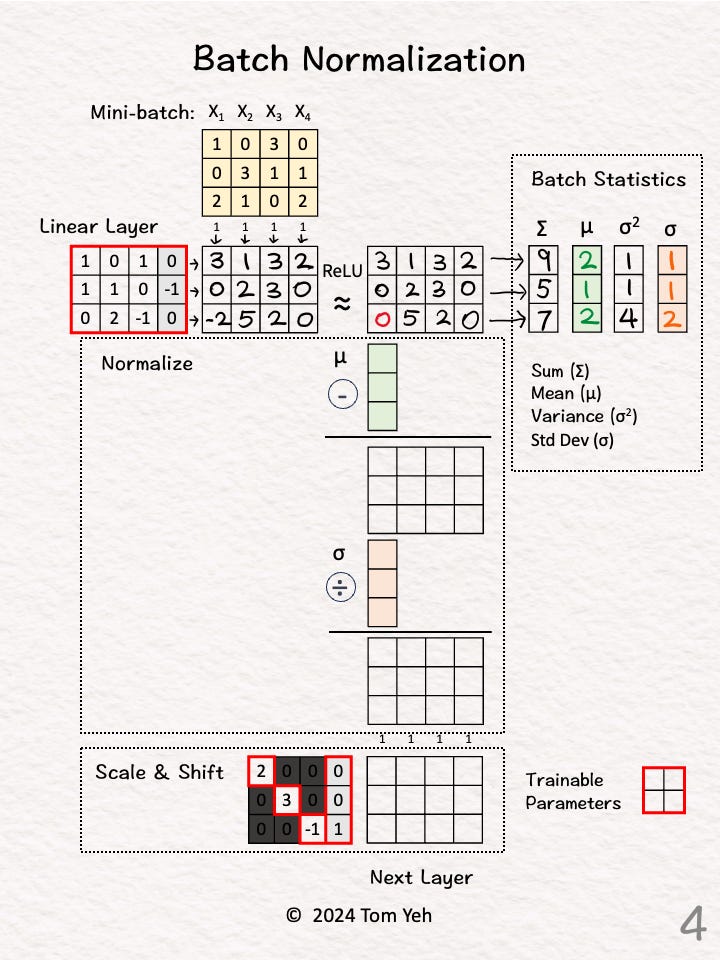
Compute the sum, mean, variance, and standard deviation across the four examples in this min-batch.
Note that these statistics are computed for each row (i.e., each feature dimension).
Step 5 of 7: Shift to Mean = 0
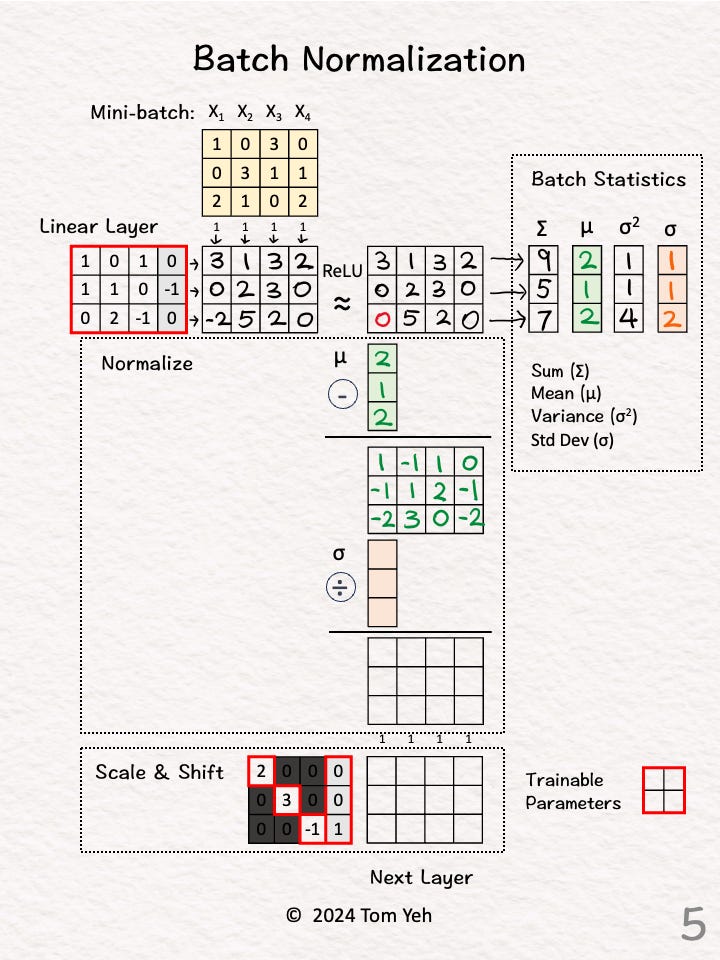
Subtract the mean (green) from the activation values for each training example
The intended effect is for the 4 activation values in each dimension to average to zero
Step 6 of 7: Scale to Variance = 1
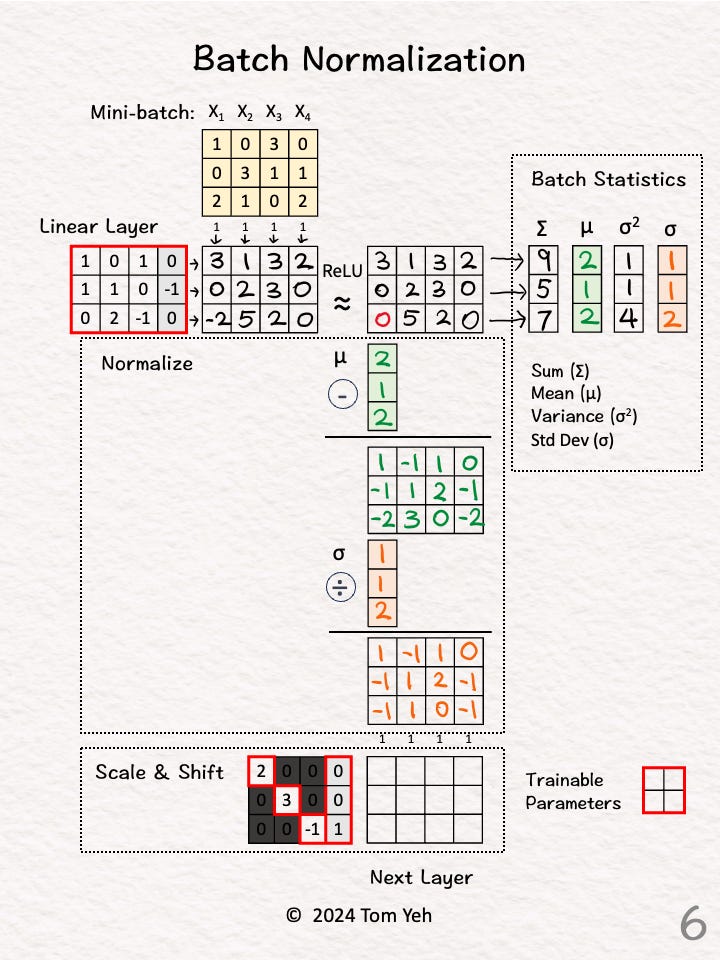
Divide by the standard deviation (orange)
The intended effect is for the 4 activation values to have variance equal to one.
Step 7 of 7: Scale & Shift
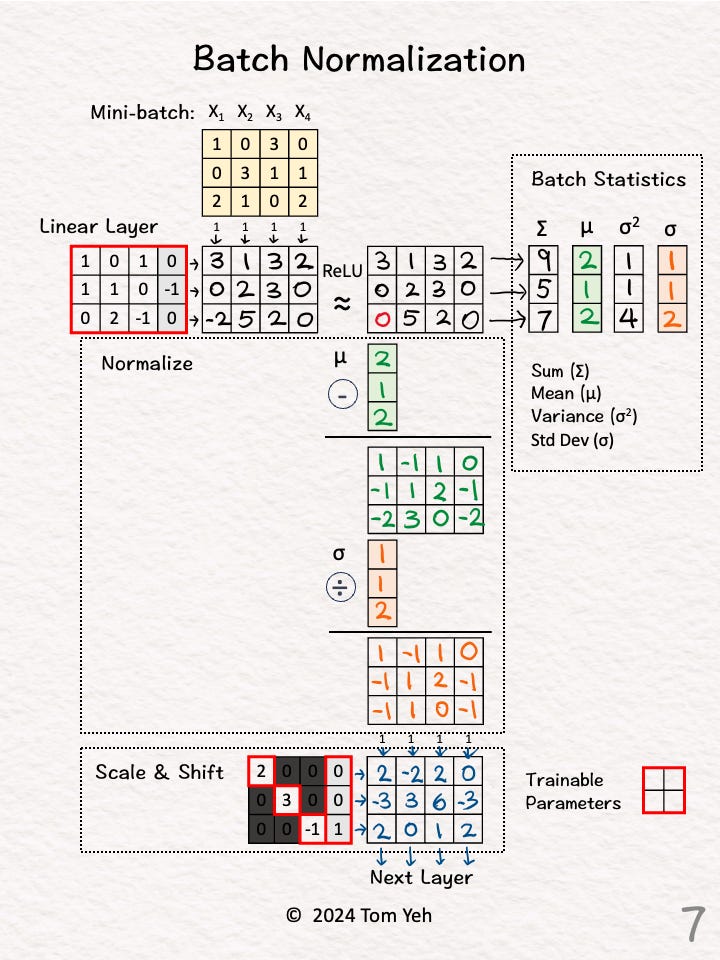
Multiply the normalized features from [6] by a linear transformation matrix, and pass the results to the next layer
The intended effect is to scale and shift the normalized feature values to a new mean and variance, which are to be learned by the network
The elements in the diagonal and the last column are trainable parameters the network will learn.
Download
⬇ Batch Normalization (7 pages)