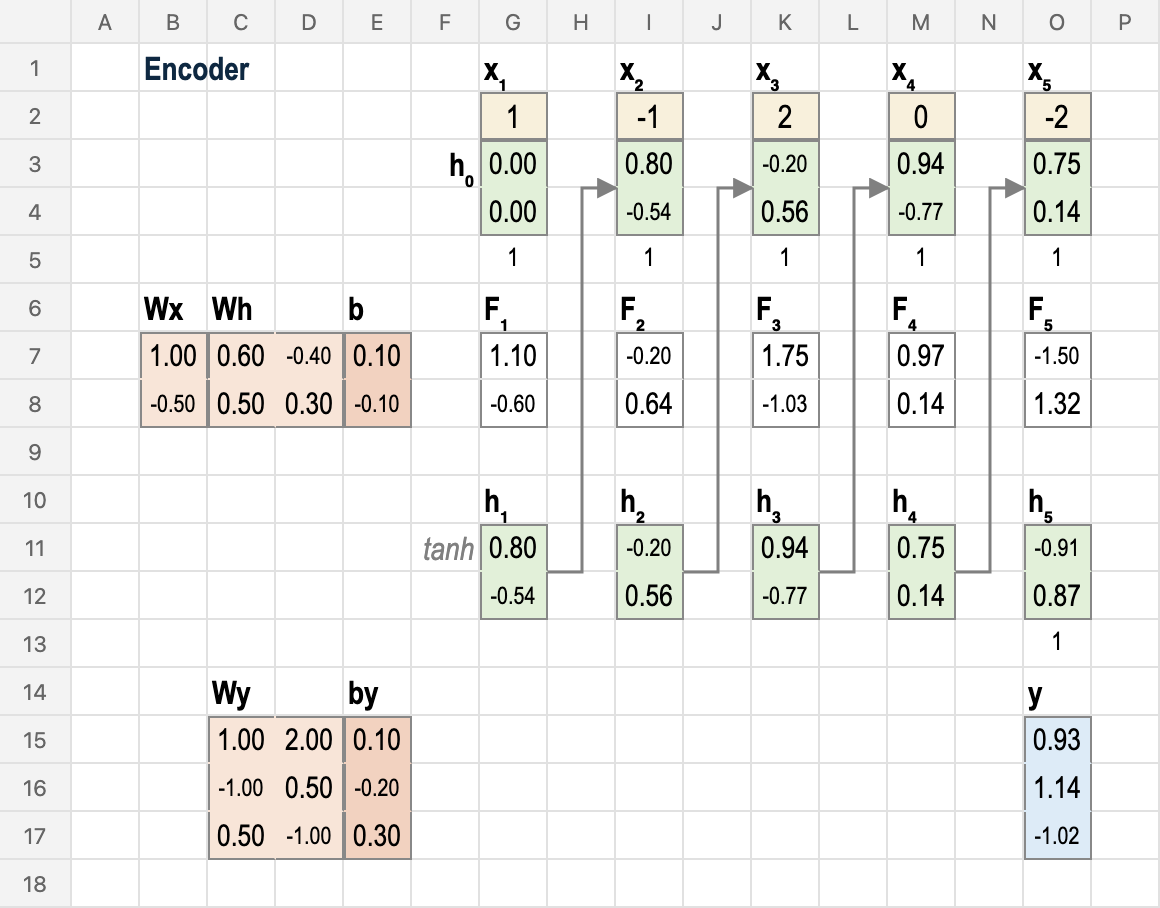
In the last article, our network read a sequence and gave its answers along the way. In this article, the answer is a sequence too. How does a network turn one sequence into another? We build it from two halves. An encoder reads the input sequence into one vector. A decoder turns that vector into an output sequence. Together, they form a sequence-to-sequence network, or seq2seq.
d=1, h=2, y=3, seq=5, many-to-one
We start with the encoder. It is a many-to-one RNN, as in the Outputs article. We label it Encoder, at the top left. Its one output, y, is what the encoder knows about the whole sequence. Compare y with the Outputs article, and you find the last output of its y=3 example.