

Library › Calculating AI by Hand ✍️
U-Net by Hand ✍️
Reinforcement Learning with Human Feedback (RLHF) by Hand ✍️
A U-Net is an encoder-decoder network with skip connections, widely used for image segmentation and as a backbone of diffusion models. Its "U" shape contracts an image down to a compact representation, then expands it back to full size, carrying fine detail across the middle through skip connections.
In this by-hand layout, each feature is drawn as a column vector, so the familiar U is rotated 90 degrees and appears as a C.
How does a U-Net work?
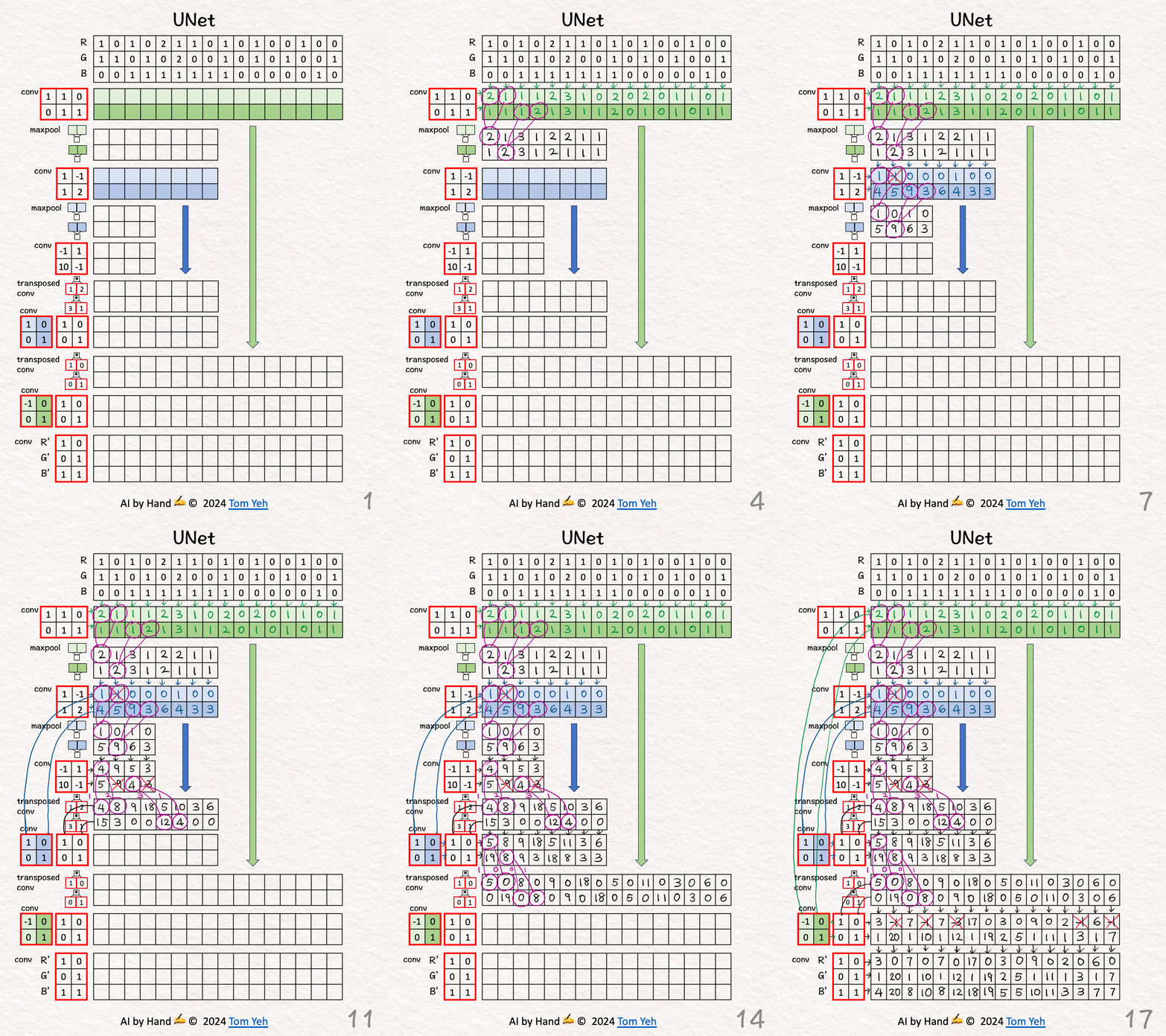
Setup
Step 1 of 11: Given
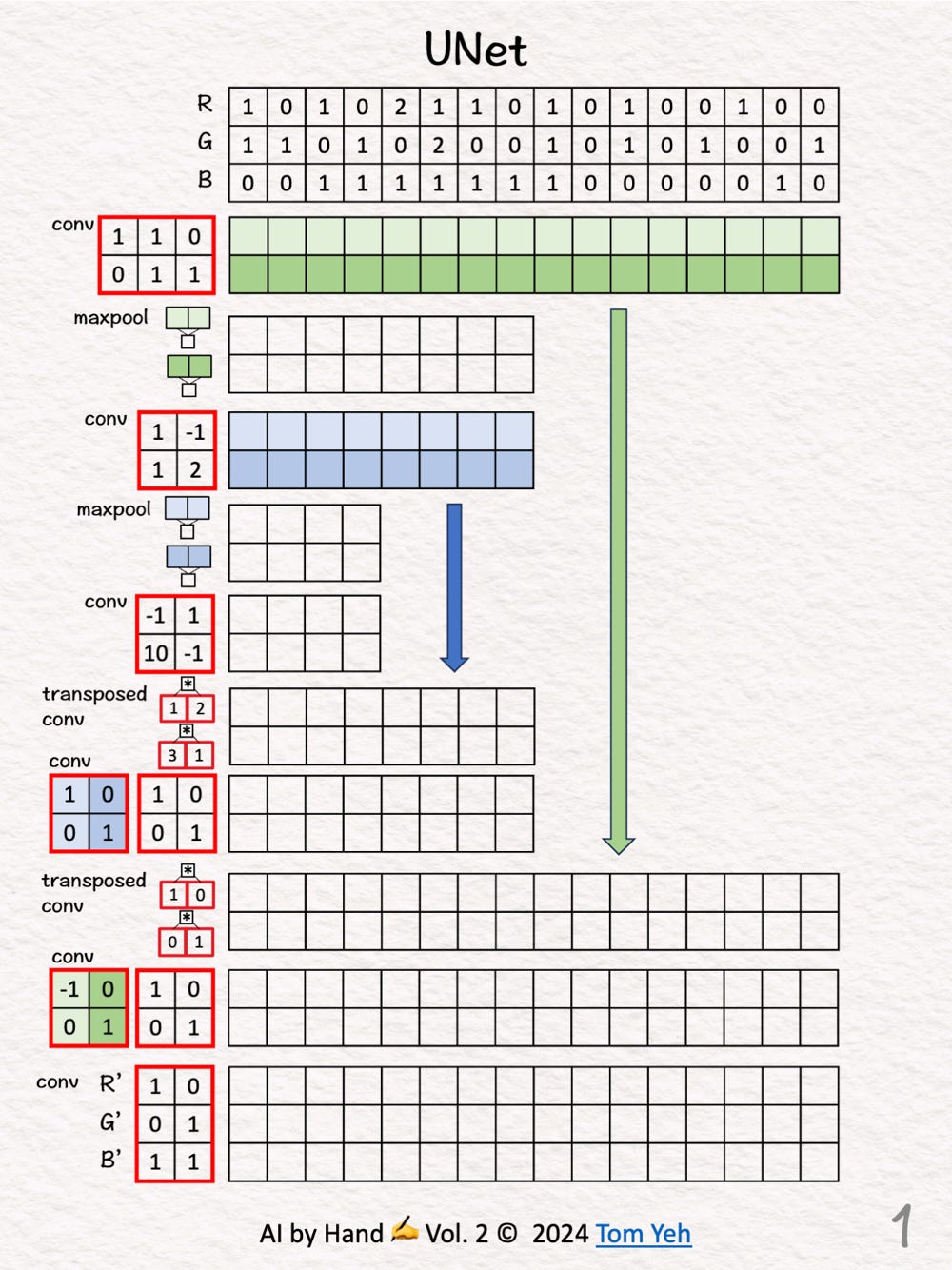
An input image with three channels (R, G, B), and the U-Net's convolution and pooling weights.
Encoder (Contracting Path)
Step 2 of 11: Convolution 1
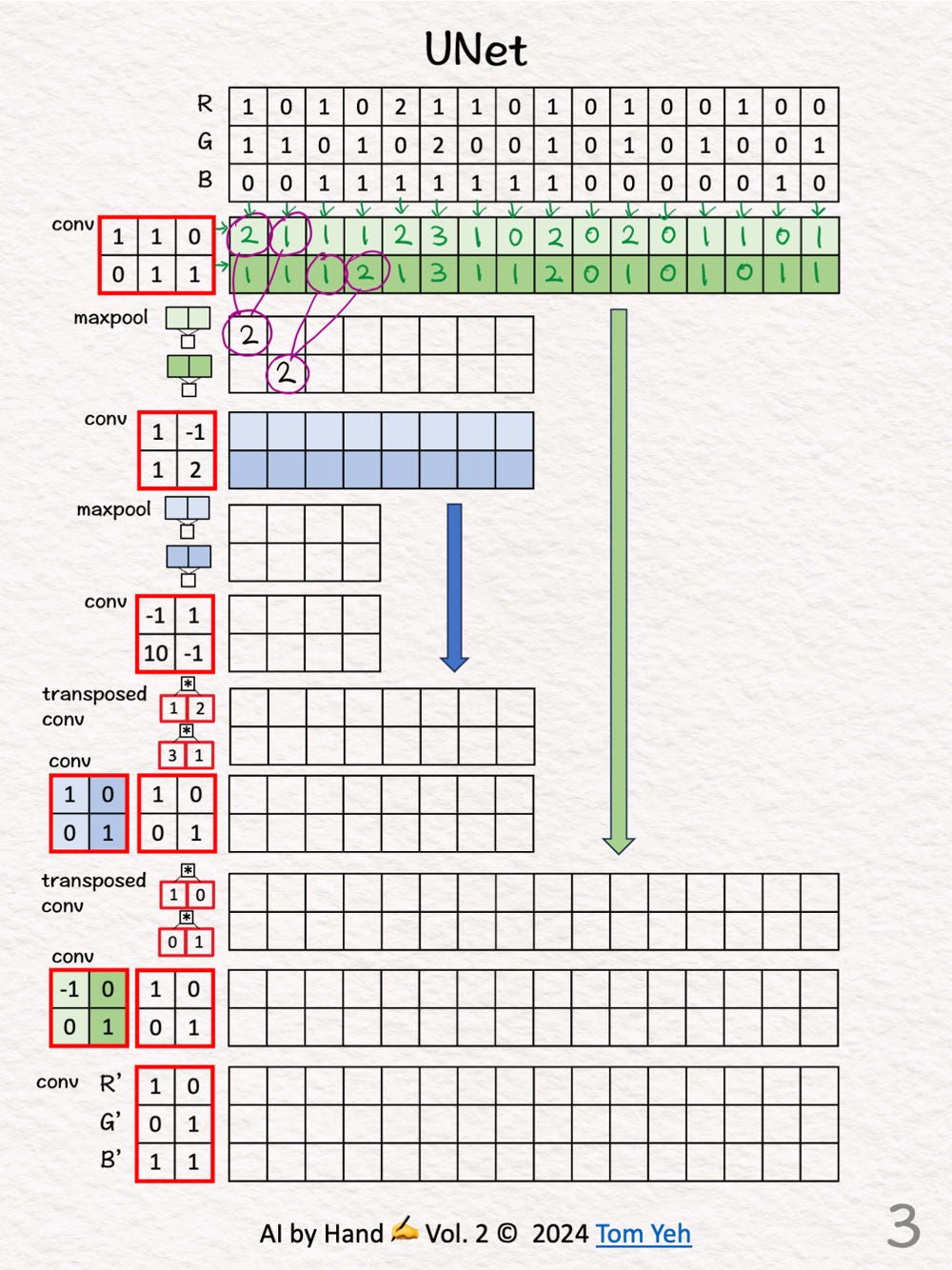
Slide the first convolution kernel over the input to produce a feature map (green).
Step 3 of 11: Max Pool 1
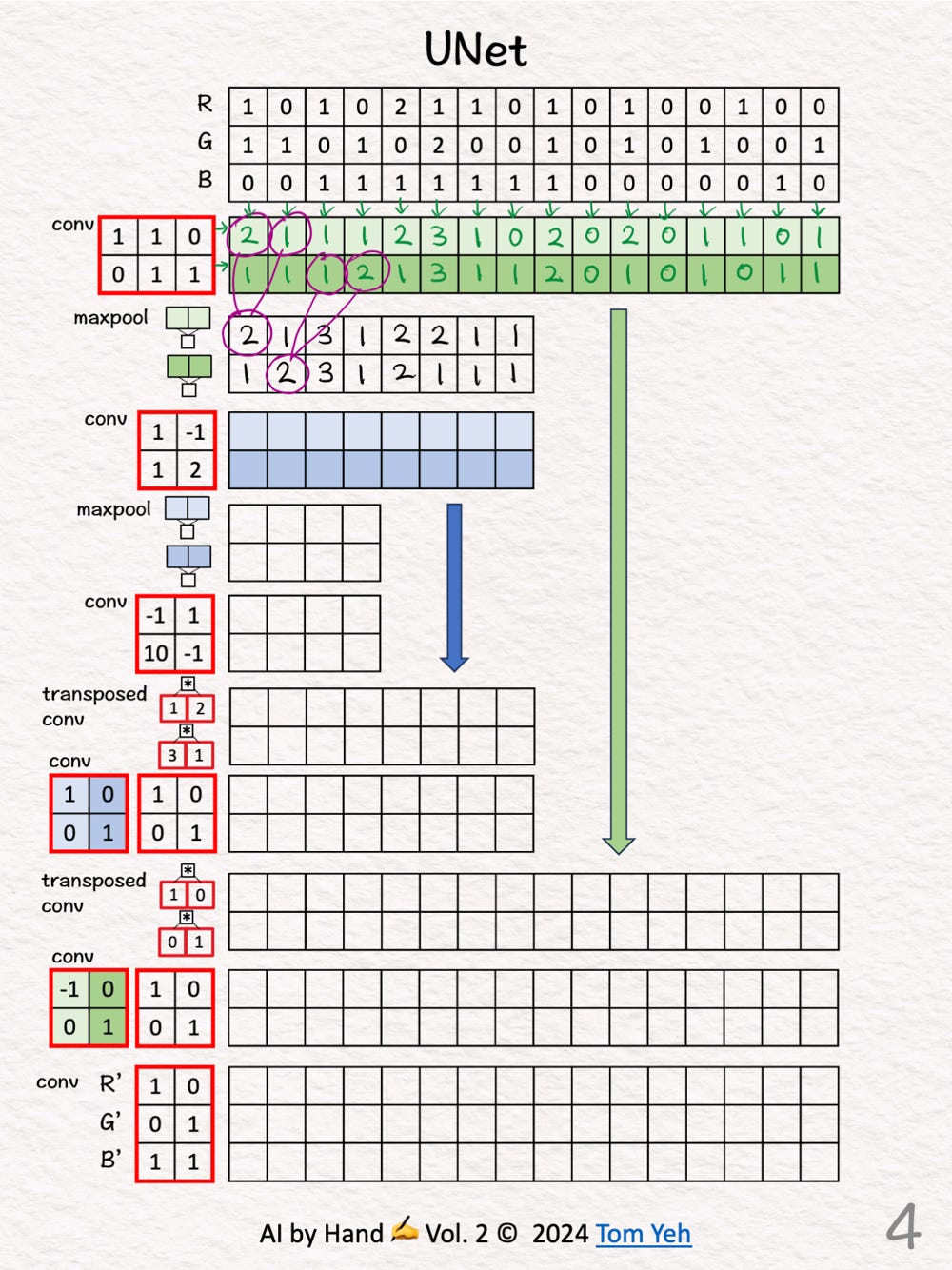
Downsample the feature map by taking the maximum of each region.
Members read on: the rest of the walkthrough and the printable PDF.